

What Is CO2 Laser: Skin Rejuvenation & Resurfacing Guide
Your in-depth look at fractional CO2 lasers, their science, and how they can rewrite years of texture change, wrinkles, and acne scars.
Estimated Reading Time
14–18 minutes
Key Takeaways
- CO2 Fractional Laser = Ablative resurfacing that vaporizes micro-columns of skin for deep collagen remodeling.
- Recovery ~5–10 days: Expect peeling, redness, and post-laser care with ointments and vinegar soaks.
- Improvements in texture & scars: Often ~50–70% for acne scars, ~40–60% for etched lines.
- Powerful single-session results: Beats many non-ablative lasers that require multiple visits.
- Cost in Northern VA: ~$2,000–$3,500 for full-face fractional CO2; can be more with neck/chest add-ons.
Table of Contents
- Introduction
- What Is a CO2 Laser?
- The Science
- What Does a CO2 Laser Treat Best?
- Ideal Candidate
- Treatment Day
- Recovery Timeline
- Results
- Cost & Value
- Device Safety
- CO2 Laser vs Alternatives
- Finding a Provider “Near Me”
- FAQ
Introduction
What if one high-precision laser session could rewrite years of texture, scars, and sun damage? A CO2 fractional laser uses 10,600 nm light to vaporize tiny micro-columns of skin, sparking a repair wave that smooths wrinkles, tightens pores, and softens acne scars through long-term collagen remodeling. Whether you’re looking up Mayo Clinic notes on “laser resurfacing” or searching for a CO2 laser near me in Fairfax, this procedure packs serious rejuvenation power—but also requires planning for downtime, cost, and safety. Let’s walk through the important facts and what you can expect.
What Is a CO2 Laser?
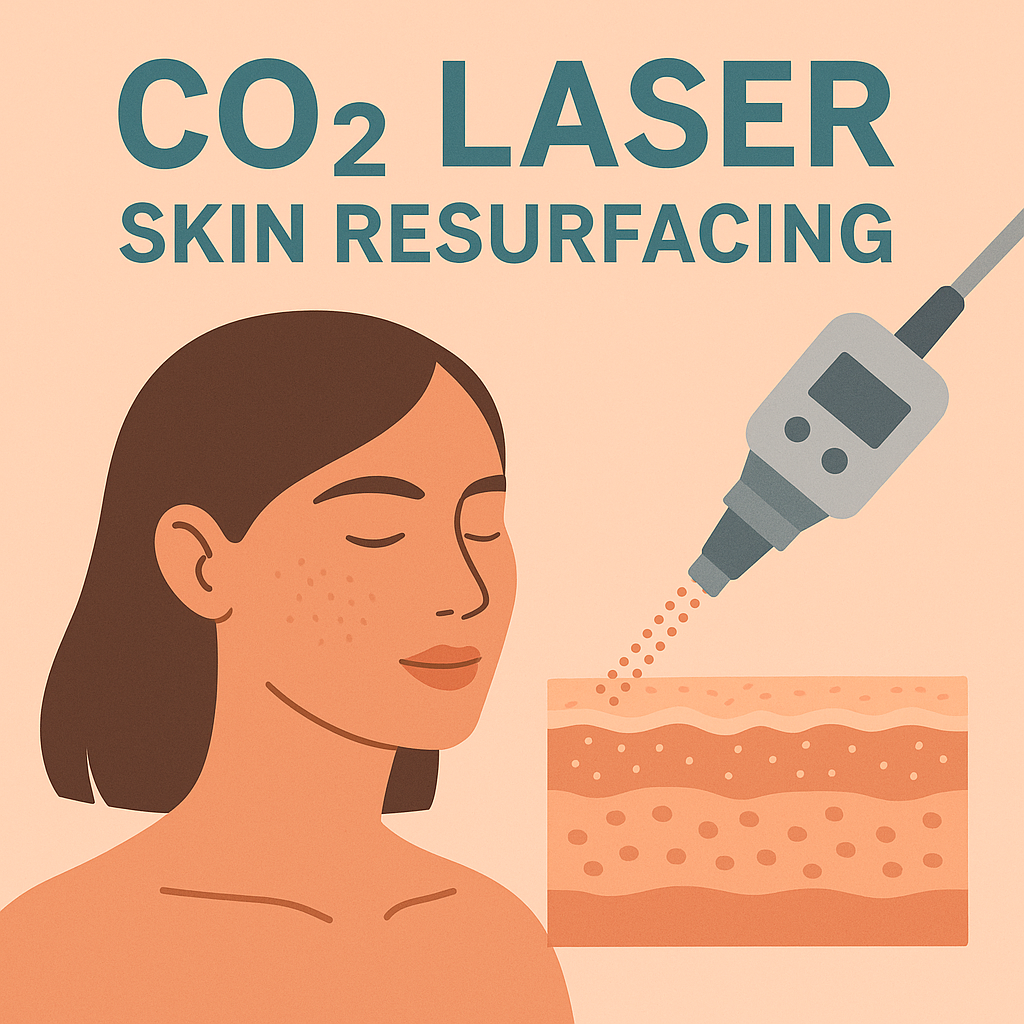
A CO2 laser is an ablative carbon-dioxide laser that emits 10,600 nm infrared light. This light targets water in skin cells, instantly vaporizing tiny columns of tissue. There are two main modes:
- Fully ablative CO2: Treats the entire surface in one pass (more downtime, higher risk).
- Fractional CO2 laser: Delivers a pattern of “micro-dots,” removing 15–30% of skin surface each session. This is the modern standard.
Brand names vary: Fraxel Repair is fractional CO2, while Fraxel Dual is non-ablative 1550 nm (not the same). Leading fractional CO2 devices—such as Solaria CO2 laser, Lumenis UltraPulse, and DEKA SmartXide—all use 10,600 nm with different scanning modes.
Dermatologists often call fractional CO2 the “gold standard” for deep wrinkles and scars because of its balance of ablation and collagen stimulation. For further reading, see BH Skin Dermatology on CO2 benefits.
The Science
Fractional CO2 lasers create thousands of microscopic thermal zones (MTZs). Each MTZ vaporizes the epidermis and induces thermal coagulation in the dermis. Surrounding skin is left intact for faster healing. Over 4–6 weeks, fibroblasts boost collagen production—often up to 40% more by month 6. Non-ablative lasers typically yield ~5–10% collagen bump, so fractional CO2 often has more dramatic results.
Collagen remodeling timeline: 3–6 months of gradual improvement. One PubMed review found a ~45% wrinkle depth reduction at 3 months. By tackling deeper skin layers, CO2 lasers excel at smoothing texture and significantly reducing etched lines.
What Does a CO2 Laser Treat Best?
Wrinkles & fine lines: Especially around eyes, mouth, and forehead.
Acne scars: Rolling and boxcar scars can improve 50–70% after 1–2 sessions. Ice-pick scars may need a punch excision first. See North Dallas Dermatology for more details.
Sun damage & texture: Blotchy pigment, coarse texture, enlarged pores, and mild laxity see real benefits. Bryn Mawr Dermatology calls CO2 resurfacing a top pick for photoaging.
Many experience up to ~20% skin tightening, especially around the jawline and lower face, as noted by Healthline.
Ideal Candidate
Fractional CO2 is best for Fitzpatrick I–III, but it can be done on darker skin types (IV–V) with caution (test spots, pigment-suppressants). Avoid if you’ve used isotretinoin (Accutane) in the last 6 months or have active infections. If you have higher skin types and want less risk of pigmentation, consider Morpheus8 radiofrequency microneedling instead.
Preparation tip: Fall or winter sessions lower sun-exposure risk. If you’re prone to cold sores, start antiviral prophylaxis pre-treatment.
Treatment Day
Before photos & prep: Your skin is cleansed, numbing cream applied (45 minutes). For upper-lip lines, a dental block can help.
During: You wear eye shields, and a smoke evacuator is used. The laser passes feel like warm snaps—pain rated ~3–4/10 with good anesthesia. Active lasering often lasts under 10 minutes for a full face. ABCS info notes how quick it can be.
After: Mild pinpoint bleeding, white frosting, and crusting are normal. An occlusive barrier is applied. Some providers mention it’s similar in discomfort to a deep facial, surprisingly tolerable with numbing and good technique.
Recovery Timeline
Days 0–3: Weepy, yellowish crusting, swelling—normal as the skin barrier repairs. Vinegar soaks every 4 hours, constant ointment.
Days 4–7: Peeling in sheets, intense redness. Do not pick. Keep moisturizing. Many can return to public around day 7–10. MedicalNewsToday has a healing stages overview.
Week 2–4: Pinkness fades; mineral makeup can conceal remaining redness. SPF 50+ and sun avoidance are crucial to prevent hyperpigmentation.
Plan social downtime of ~7 days, but true skin normalization can take weeks—especially for deeper passes.
Results
At ~3 weeks, you’ll see smoother texture and smaller pores. By months 3–6, collagen peaks, improving wrinkles and scars up to ~45% or more. For acne scars, rotating photos at 1 and 3 months shows dramatic changes. BH Skin Dermatology notes a two-grade drop on the Goodman-Baron acne scar scale for many after a single pass.
With diligent sun care, results can last 5–10 years. Maintenance might include mild lasers or microneedling. For deeper sets of wrinkles or advanced scars, 1–2 CO2 sessions spaced a few months apart may be ideal.
Cost & Value
In Northern Virginia, fractional CO2 laser often ranges $2,000–$3,500 for a full face; adding neck can total $4,000–$5,500. This aligns with national cost data from Healthline.
Value tip: Compare to ~3 sessions of non-ablative lasers at ~$1,200 each, which can approach the same total cost but deliver lesser changes. CO2 is often a one-time big result with possible annual touch-ups.
Device Safety
Fractional CO2 requires certified operators and proper eye protection, plus a medical smoke evacuator. An industrial CO2 laser cutter uses much higher power for metal or wood—it’s completely different. Ensure your provider follows ANSI Z136 protocols and uses a ULPA filter to reduce plume risks. Mayo Clinic’s laser guidelines emphasize trained providers for best outcomes.
CO2 Laser vs Alternative Treatments
Chemical peels: Less precise depth, multiple sessions for deep wrinkles. For a breakdown, read chemical peel vs skin resurfacing.
Erbium:YAG laser: Good for moderate lines, less heat than CO2, but typically less collagen remodeling.
Radiofrequency microneedling (Morpheus8): Less risk for darker skin, minimal downtime, but milder improvement for severe wrinkles. Learn more about Morpheus8.
Neuromodulators (Botox/Dysport): Great for dynamic wrinkles, but no texture or scar improvements alone—sometimes paired with CO2. For guidance, see Botox vs Dysport.
If you want complete clarity on microneedling, check the microneedling guide.
Finding a Provider “Near Me”
Searching “CO2 laser near me” or “CO2 laser Falls Church” in Northern Virginia? Look for a clinic with:
- Board-certified supervision and laser training.
- Transparent device info—ask brand and typical settings.
- Realistic before/after photos showing consistent lighting.
- Proper safety gear: eye shields, smoke evacuator, emergency protocols.
Inquire about downtime, cost, past results, and pigment-prevention steps if you have a higher Fitzpatrick type.
FAQ
What is a CO2 laser in one line?
A 10,600 nm ablative laser that vaporizes micro-columns of skin to ignite new collagen growth and reveal smoother skin.
How painful is CO2 laser?
With strong topical and local anesthesia, most rate discomfort ~3–4 out of 10. It’s brief—usually under 10 minutes of active lasering.
What is typical CO2 laser downtime?
About 5–7 days of peeling, redness, and crusting; pinkness can linger a few weeks but is easy to cover with makeup after day 8.
How much does it cost?
A full-face fractional CO2 in Northern VA often runs $2,000–$3,500; it can climb higher with neck or chest add-ons.
Does one session fix acne scars?
Rolling and boxcar scars can improve 50–70% after 1–2 sessions. Ice-pick scars usually need punch excision or alternate therapy first.
When do final results show?
You’ll see surface changes by week 3, with full collagen remodeling around months 3–6.
Is Fraxel the same as CO2?
Only Fraxel Repair is fractional CO2. Other Fraxel models (e.g., Fraxel Dual) are non-ablative and don’t vaporize tissue.
Sources
[1] mayoclinic.org
[2] bhskin.com
[3] americanboardcosmeticsurgery.org
[4] pmc.ncbi.nlm.nih.gov
[5] northdallasderm.com
[6] brynmawrdermatology.com
[7] healthline.com
[8] medicalnewstoday.com
[9] drhconsult.co.uk
[10] prolase-medispa.com
[11] prolase-medispa.com
[12] prolase-medispa.com
[13] prolase-medispa.com

