

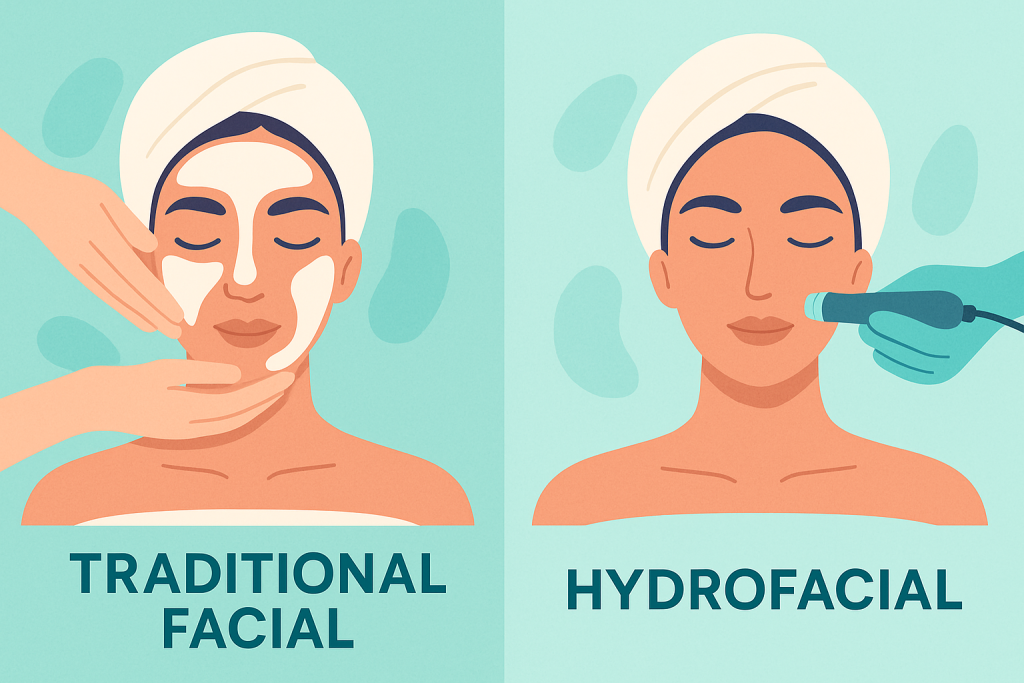
What Is Hydrofacial vs Traditional Facial – Which Wins for Real-World Results in Northern Virginia?
Confused about what is hydrofacial and whether it outperforms the traditional facial you’ve booked for years? Here’s a clear, friendly, medical-esthetic take. In this guide, we compare technology, results, comfort, price, and pair-ability so you can choose with confidence. If you live or work in Fairfax, Falls Church, Sterling, or Loudoun and you’re searching “hydrofacial near me,” you’re in the right place. We offer HYDROfacial technology (non‑branded). We do not offer the trademarked HydraFacial®. You’ll see why our patients in hydrofacial Fairfax, hydrofacial Falls Church, hydrofacial Sterling, and hydrofacial Loudoun love the glow, the clean pores, and the zero downtime.
Let’s define terms, then go point by point so you can pick the best fit for your skin and your calendar.
Estimated Reading Time
12–14 minutes
Key Takeaways
- Hydrofacial = consistency: Water-dermabrasion plus suction removes debris gently, delivering instant glow.
- Traditional = variability: More spa-like, hands-on approach, but can be less predictable.
- Zero or short downtime: Hydrofacial typically has no redness; traditional may cause mild redness or purging.
- Cost-value ratio: Hydrofacial bundles multiple modalities in one session, often justifying the higher price.
- Pair-ability: Hydrofacial’s gentler approach fits well with other treatments (like LED or microneedling) for more comprehensive results.
Table of Contents
- Introduction
- What Is a Hydrofacial?
- What Is a Traditional Facial?
- Quick Comparison: Traditional Facial vs Hydrofacial
- Detailed Pros & Cons + Value
- Skin Concerns Hydrofacial Treatments Address Best
- Ideal Candidate for Hydrofacial Near Me
- How Often & Cost Math
- Pair-Ability & Add-ons with the Hydrofacial Machine
- Local “Near Me” Guide
- Cost & Pricing Transparency
- Safety, Aftercare, & Expected Results
- Final Verdict
- Closing Call-to-Action
- FAQ
- Sources
Introduction
If you’re new to the world of hydrofacial vs traditional facial, you might be asking: “Do I really need a fancy machine? Isn’t a classic facial enough?” Below, we’ll break down each modality’s process, what to expect for comfort and downtime, typical costs, and which skin types benefit the most. By the end, you’ll be fully prepped to make a confident choice for your next appointment.
What Is a Hydrofacial?
A hydrofacial is a water-powered dermabrasion treatment that cleanses, exfoliates, performs painless vacuum extractions, and infuses condition-specific serums in a single pass. Think of it as gentle hydradermabrasion plus serum delivery for a quick, precise, and consistent treatment.
Key components include a closed-loop fluid system, adjustable hydro-dermabrasion tip, vortex suction, and disposable tips. It’s spelled both “hydrofacial” and “hydro facial” but references the same water-dermabrasion device class.
- Closed‑loop fluid system: Clean solution enters; waste fluid exits, enhancing hygiene and flow.
- Vortex suction: Whisks away oil and blackheads without uncomfortable squeezing.
- Disposable tips: Single-use for each face, minimizing cross-contamination.
Typical protocols involve cleansing, aqua-peel exfoliation, a gentle chemical peel, vacuum extractions, targeted serum infusion, and SPF to finish. Many systems also feature built-in LED, lymphatic drainage, ultrasonic spatula, oxygen mist, or low-level microcurrent. The result? Instant glow and no downtime. Studies and anecdotal reports note machine consistency reduces guesswork and painless extractions. Many see results even on sensitive skin [0].
Downtime? Zero. You can apply makeup and return to work or school right away.
What Is a Traditional Facial?
A traditional facial is a hands-on spa treatment, typically including manual cleansing, steam, optional enzymes, hand extractions, facial massage, a mask, and moisturizer with SPF. While it can be very relaxing, results depend heavily on the esthetician, the products used, and the client’s skin type. This variation can be both a pro and a con [1].
- Typical session: 60–90 minutes.
- Extractions may feel pinchy or sore on congested areas.
- You might see redness or a “purge” for 24–48 hours.
- Skill and product choices vary widely among spas [2].
Cost: In Northern VA, the average is $90–$150 (higher if premium masks or add-ons are included).
Quick Comparison: Traditional Facial vs Hydrofacial
Here’s a quick snapshot [2, 3]:
- Technology
- • Hydrofacial: Water-dermabrasion device with vortex suction + serums.
- • Traditional: Manual cleansing, steam, hand extractions.
- Customization Depth
- • Hydrofacial: Serum cartridges, LED, lymphatic, etc.
- • Traditional: Product swaps, massage style, mild peel options.
- Comfort Level
- • Hydrofacial: Cooling flow, controlled suction.
- • Traditional: Manual extractions can hurt more.
- Downtime
- • Hydrofacial: None.
- • Traditional: Possible redness/purge ~1–2 days.
- Result Longevity
- • Hydrofacial: Glow ~3–4 weeks.
- • Traditional: Glow ~3–7 days.
- Average Session Cost
- • Hydrofacial: $175–$275.
- • Traditional: $90–$150.
Detailed Pros & Cons + Value
Precision & Hygiene: Hydrofacial tips are single-use, and the system is closed and consistent—this lowers cross-contamination risk [7]. Traditional facials can be equally clean, but it depends on the spa’s protocols.
Efficacy on Congestion: The vortex suction is excellent for blackheads and oil plugs, especially around the T-zone. This can beat manual squeezing in many cases [5].
Comfort: The gentle vacuum plus cooling fluid in a hydrofacial spares you from pinching or scraping. Most clients say it’s pain-free.
Customizability: Hydrofacial boosters target acne, pigment, or hydration. Add-on LED or oxygen mist can elevate results. Traditional facials can use different masks or oils, but rely more on technician skill.
Cost & Value Note: Hydrofacials are priced higher but bundle multiple modalities—exfoliation, peel, painless extraction, infusion, LED, etc.—into one 30-minute session. It can be more time-efficient and results-driven.
Skin Concerns Hydrofacial Treatments Address Best
Hydrofacial treatments target oily or congested pores, dull or dehydrated skin, rough texture, and early fine lines. They are generally safe across all Fitzpatrick skin types. Contraindications include open lesions, active cold sores, recent isotretinoin, and caution in pregnancy or nursing [4].
Ideal Candidate for Hydrofacial Near Me
• Busy professionals: No downtime, so you can glow for same-day events.
• Teens & adults with blackheads: Great for clearing pores regularly without pain.
• Brides & grooms: Book ~3–7 days pre-wedding for that dewy look.
• Not ideal right now: If you have active cystic acne, uncontrolled rosacea, recent Accutane use, or have open lesions, wait until skin is stable.
How Often & Cost Math
Most do hydrofacial sessions every 4–6 weeks. This aligns with the skin’s ~28-day renewal cycle, preventing buildup of oil and debris. For correction, do 3–4 sessions spaced 3–4 weeks apart, then maintain every 6–8 weeks. For events, aim for ~3–7 days pre-occasion.
In Northern VA, a single hydrofacial session might be $225. Package pricing can drop the per-session cost and often includes add-ons like LED or serums for free. Value tip: If you need frequent facials or want long-term changes, the higher hydrofacial price can still be cost-effective per result.
Pair-Ability & Add-ons with the Hydrofacial Machine
In-device modules include LED therapy, lymphatic drainage, ultrasonic spatula, or oxygen infusion—very handy for tweakable results. Great companion procedures often scheduled around a hydrofacial:
- Microneedling: Do a hydrofacial ~1 week before or ~10 days after to clear pores and enhance skin readiness [8].
- Morpheus8: Space 1–2 weeks apart to manage dryness or flaking [9].
- Chemical peels: Alternate or combine mild peels for extra brightening [10].
- Neuromodulators: Typically do the hydrofacial first, then Botox/Dysport can follow same day or within 48 hours [11].
What NOT to combine same-day: Medium or deep chemical peels, ablative lasers, or dermal fillers (that need to remain undisturbed) are usually spaced 1–2 weeks apart.
Local “Near Me” Guide
Hydrofacial Fairfax: Quick in-and-out near main corridors, consistent machines if you visit multiple branches.
Hydrofacial Falls Church: Evening hours near commuter routes, same HYDROfacial system for reliable settings each visit.
Hydrofacial Sterling: Accessible from Route 7 & 28, weekend timings, charted serum boosters so each session builds on the last.
Hydrofacial Loudoun: Convenient for Ashburn, Broadlands, with comprehensive protocols from the same family of machines.
When searching “hydrofacial near me,” confirm medical oversight, single-use tips, and adjustable suction. See our clinic checklist here [12].
Cost & Pricing Transparency
Hydrofacial cost: $175–$225 per session (base). Add-ons like LED or lymphatic may cost ~$30 each. Monthly memberships can lower per-session rates to ~$149.
Traditional facial cost: ~$90–$150. Less overhead but not always as transformative or consistent.
Why the price gap? Hydrofacial devices use consumable cartridges and single-use tips, which increases overhead, but you receive multiple modalities in one short visit. For many, the glow lasts longer too [7].
Safety, Aftercare, & Expected Results
Immediately post-treatment: Mild pinkness for 30 minutes is normal. Some pinpoint red dots can appear around nostrils if you had congestion. Usually fades fast.
First 48 hours: Cleanse gently, use a simple moisturizer, wear SPF 30+ daily. Avoid retinoids and scrubs for ~2 days. No intense workouts or saunas for 12 hours. Expect fresh glow right away.
Results timeline:
- Immediate: Bright, hydrated look.
- Day 3–5: Deeper congestion clears.
- Day 7: Hydration often peaks; makeup glides smoothly.
- Long-term: Monthly sessions build cumulative improvements in texture and clarity.
Adverse events are rare, with mild dryness or tightness being the most common. Larger issues remain below 2% in general practice [6].
Final Verdict
For lasting glow, painless extractions, and consistent results, the hydrofacial is a strong winner in most cases. Traditional facials can be a lovely, luxurious treat—especially if you enjoy a long, hands-on pampering session. Ultimately, many people alternate between the two: hydrofacial for deep cleaning and immediate, longer-lasting radiance; traditional facial for the spa experience and extended massage. Pick based on your skin goals and time available.
Closing Call-to-Action
Ready to see your glow? Book a complimentary skin analysis and your first hydrofacial if you’re near Fairfax, Falls Church, Sterling, or Loudoun. Reserve online or call us at [phone]. Get event-ready skin in just 30 minutes with our customized hydrofacial treatments.
FAQ
Is a hydrofacial good for acne-prone skin?
Absolutely. Salicylic or clay-based boosters plus gentle suction reduce blackheads without trauma. Blue LED can also help calm acne bacteria.
Hydrofacial vs microdermabrasion—what’s the difference?
Traditional microdermabrasion uses crystals or diamond tips on dry skin. A hydrofacial uses water (hydradermabrasion) plus serums, generally making it gentler and more hydrating.
Can sensitive skin tolerate hydrofacial?
Yes. Estheticians can adjust suction and skip the peel layer or choose milder serums, making it suitable for sensitive types.
Will I purge afterward?
It’s uncommon because debris is already extracted. Some people may see minor breakouts if deeper congestion surfaces, but typically not the same as a traditional facial purge.
How do hydrofacial machines stay hygienic?
Single-use tips, sealed fluid pathways, and full system flushes after each client help reduce contamination. Strict cleaning of handpieces is also performed.
Is it covered by insurance?
No. Hydrofacial is an elective cosmetic procedure, so it’s generally self-pay.
Are side effects common?
Significant adverse effects are rare. Some experience slight dryness or tightness for a day or two [6]. Always inform your provider of any sensitivities or medications.
Sources
[0] essencemedspa.net
[1] serotonincenters.com
[2] mcskinstudio.us
[3] splendidskincarespa.com
[4] jagmedicalspa.com
[5] treasurevalleyaw.com
[6] thedentalspa.com
[7] envoguemedispa.com
[8] prolase-medispa.com
[9] prolase-medispa.com
[10] prolase-medispa.com
[11] prolase-medispa.com
[12] prolase-medispa.com

